Otis Blease (*1996) studied Drawing and Printmaking at the University of the West of England, Bristol, graduating in 2018 and receiving the Dumfries House Residency Award. In 2019, he undertook the postgraduate Drawing Year scholarship at the Royal Drawing School, London.
Drawing and printmaking remain at the core of Blease’s practice, which also encompasses painting and sculpture. His works often emerge from the intersection of these disciplines, exploring the possibilities that arise when different techniques, materials and processes converge. His practice is characterised by a sustained interest in the physical act of making and the transformation of drawn and printed forms into spatial and painterly compositions.
Alongside his artistic practice, Blease teaches at the Royal Drawing School in London and at the Summer Academy in Salzburg, Austria.
His work has been exhibited internationally, including at Kunstverein Arnsberg, Germany; Traklhaus, Salzburg; Arnolfini, Bristol; Fen Ditton Gallery, Cambridge; and Christie’s and The Violet Hour in London.
Martin Gredler, Patron
Martin Gredler (*1970) was born in Salzburg, Austria, where he continues to live and work. His artistic practice encompasses drawing, printmaking, painting and artist’s books, with a particular interest in the relationship between image, text and narrative. His works often move between different media and forms of storytelling, combining precise observation with an open-ended and sometimes subtly ironic engagement with everyday life, memory and the construction of images.
Gredler has received numerous grants and fellowships, including the Slavi Soucek Prize for Printmaking from the Government of Salzburg in 1998 and studio and travel residencies in the USA, Germany, Italy, South Africa, Cuba and Lithuania. His international working stays include New York and Boston, Berlin, Maine, Cape Town, KwaZulu-Natal, Holguín and Vilnius.
His work has been presented in solo and group exhibitions at institutions and galleries including Galerie im Traklhaus and Galerie der Stadt Salzburg, Kunstraum pro arte, Galerie Welz and the Paper Museum Steyrermühl in Austria, as well as venues in Germany, Lithuania, Hungary, Switzerland, Cuba and the USA. Recent exhibitions include specimen at GODOT Galeria, Vilnius (2026) and Text und Bild at Galerie im Traklhaus, Salzburg (2024).
Gredler has published several artist’s books, including Eine Litauische Geschichte (2026), Findling (2023), Alltag (2012), Ältere Modelle (2011) and Die Vergrämung der Kormorane (2009).
Stephen R. Mathewson (*1962, Evanston, Illinois, USA) lives and works in Vienna and Salzburg. His artistic practice encompasses painting, drawing, installation and moving image, often combining different media and approaches in works that are characterised by humour, ambiguity and a distinctive sense of narrative. Mathewson’s work frequently moves between the personal and the everyday, using found situations, cultural references and fragments of visual language to create unexpected connections and playful shifts in meaning.
Since the early 2000s, Mathewson has exhibited extensively in Austria and internationally. His solo exhibitions include presentations at GABA artspace, Mönchengladbach; puuul, Vienna; Elektro Gönner, Vienna; Schloss Goldegg; Kunstraum pro arte, Hallein; Periscope, Salzburg; Fishmarket Gallery, Northampton; and Barbara Preyer, Vienna. Recent solo exhibitions include The Kind of Gas I Run With at GABA artspace (2025) and Out the Window of the Hotel at puuul, Vienna (2021).
His work has also been shown in numerous group exhibitions at institutions and project spaces including Museum der Moderne Salzburg, Kunsthalle Wien, Zoom Kindermuseum Vienna, Parallel Vienna, FLUC, Projektraum Viktor Bucher and IG Bildende Kunst. He has collaborated with artists and filmmakers on several film projects, including Harald Hund’s Empire of Evil (2015), Johannes Gierlinger’s The Fortune You Seek Is in Another Cookie (2014) and Dariusz Kowalski’s Optical Vacuum (2008).
Hannah Tilson (*1995, London, UK) lives and works in London. Her paintings construct illusionary worlds through pattern—layered, camouflaged and seemingly in constant motion. For Tilson, pattern becomes a language of energy and transformation: it can obscure and reveal, distract and dazzle. Figures emerge and dissolve within scintillating surfaces of painted marks, their forms enveloped in veils of translucent colour and shifting visual structures.
Tilson received her BA from the Slade School of Fine Art in 2018, studied on exchange at the New York Studio School and completed the Drawing Year at the Royal Drawing School in London in 2021. She has undertaken residencies at Palazzo Monti, Brescia (2022), PLOP, London (2024) and the Grafische Werkstatt, Salzburg (2025), and participated in the Whitechapel Art Icon in London in 2024. A monograph surveying her work from 2010 to 2023 was published in 2023.
Recent solo exhibitions include Soft Cut (2023) and a further solo presentation (2025) at Cedric Bardawil, London, and Swoosh at Well Projects, Margate (2021). Her work has been included in group exhibitions including Bridge–Brücke at Traklhaus, Salzburg (2025), Artistic Noise Benefit at Kasmin Gallery, New York (2025), A Feast for the Senses at Berntson Bhattacharjee, London (2024), Patterns of Intimacy at MINT, Munich (2024), and Tessellations at Cedric Bardawil, London (2024).
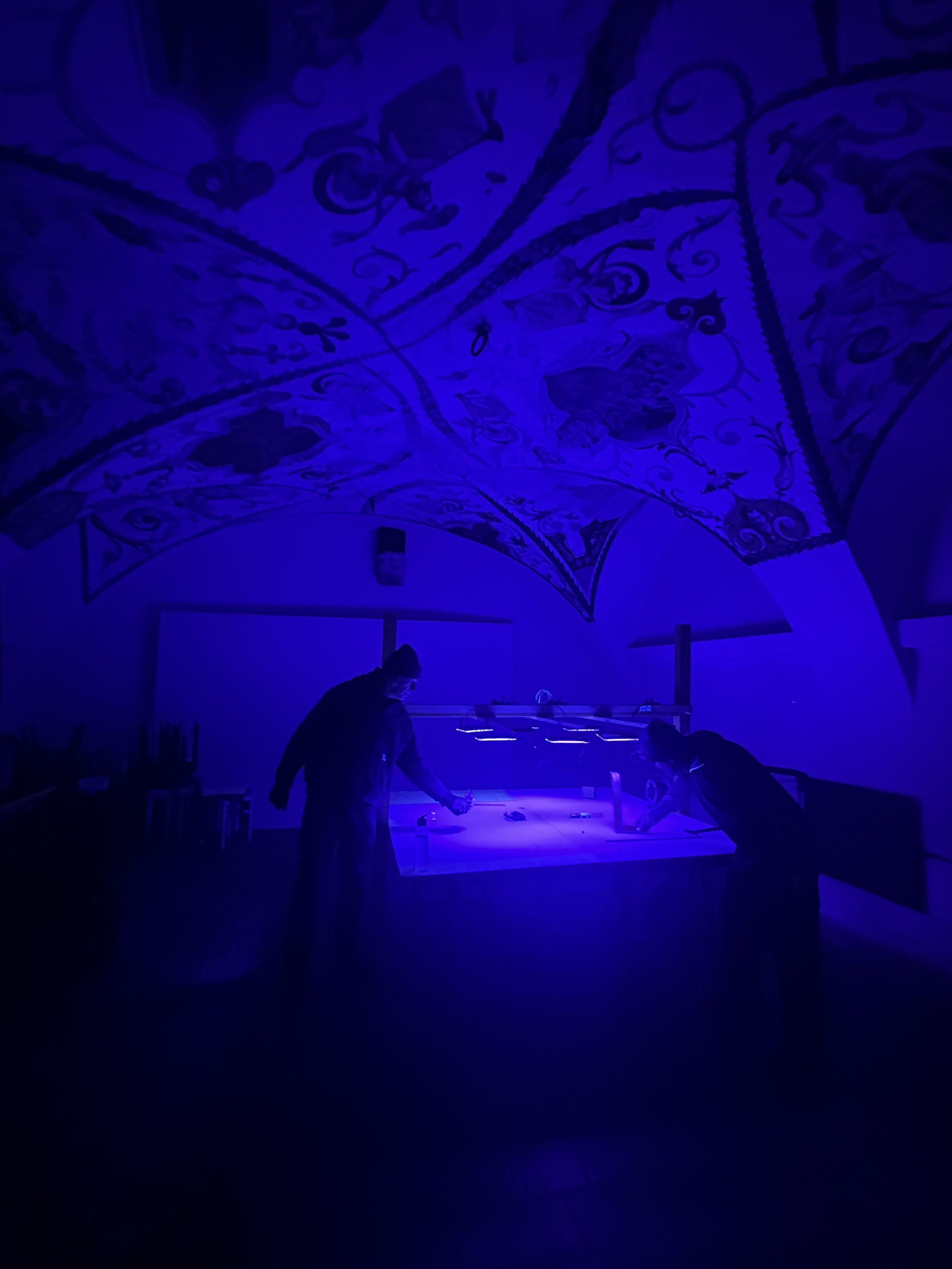
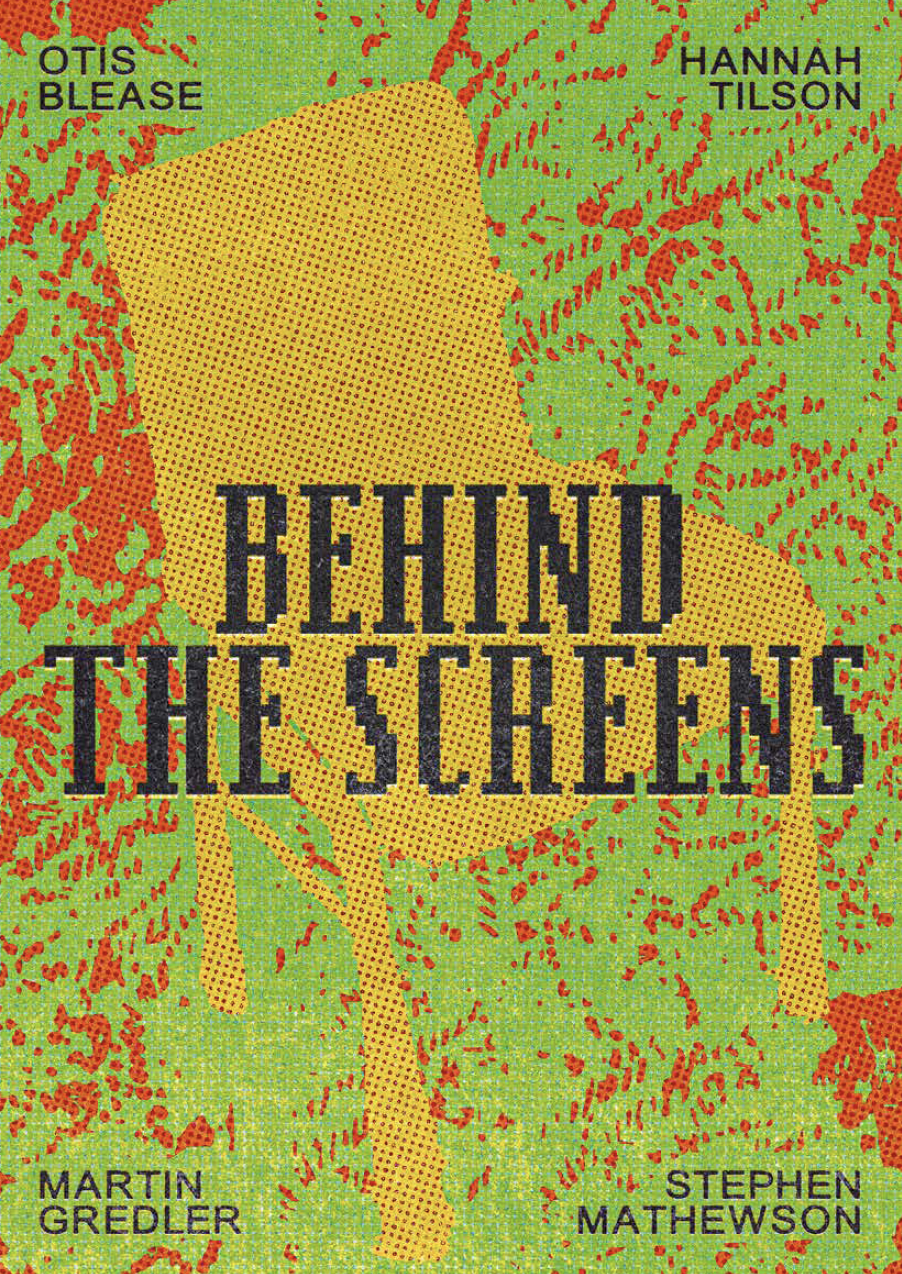
Behind the Screens.
Otis Blease
Martin Gredler
Stephen Mathewson
Hannah Tilson
A traveling exhibition by WhiskeyBusiness
Ausstellung
Eröffnung | Mittwoch, 11.11.2026, 19 Uhr
Ausstellungsdauer | bis 4.12.2026
Öffnungszeiten | jeweils Mittwoch - Freitag, 15 - 18 Uhr und nach Vereinbarung.
Ergebnisse des Siebdruck Symposiums 2026
Eine Kooperation der Int. Sommerakademie Salzburg und der Grafischen Werkstatt im Traklhaus
Die Technik des Siebdruckes, auch als Serigrafie bekannt, ist ein vielseitiges Druckverfahren, das ursprünglich aus der industriellen Produktion stammt und seit dem 20. Jahrhundert zunehmend in der bildenden Kunst Anwendung findet.
Während der traditionelle Siebdruck auf standardisierte Abläufe und reproduzierbare Ergebnisse abzielt, hebt sich der experimentelle Siebdruck durch seine Offenheit für kreative Prozesse und unkonventionelle Techniken hervor. Die Erstellung einer klassischen Auflage tritt zugunsten des Unikatdruckes zurück.
Über einen Zeitraum von 16 Tagen treffen sich die Künstler:innen in dem „schönsten Atelier der Welt“, um gemeinsam zu entwickeln und zu drucken. Die Burg als Atelier, die Festung in ihrem historischen und architektonischen Bild, wird eine permanente Begleiterin und Inspiration für den künstlerischen Prozess darstellen.
Vier Künstler:innen die gewöhnlich allein in Ihrem Atelier tätig sind, finden sich zu einem Symposium zusammen, um die Grenzen des Mediums für ihre individuellen Arbeiten auszuloten und auch an gemeinschaftlichen, kollaborativen Werken zu arbeiten. Siebe werden gemeinschaftlich verwendet, Gefundenes und Skizziertes wird eingearbeitet; gerade im Umgang mit Zufall und Improvisation soll sich die Stärke des experimentellen Absatzes wie die Kollaboration der Künstlerin und Künstlern zeigen.
Die Künstler:innen haben sich zum Ziel gesetzt, eine repräsentative Ausstellung mit vier großformatigen Siebdrucken auf Leinwand sowie einem Portfolio mit kleinformatigen Arbeiten auf Papier zu erarbeiten.
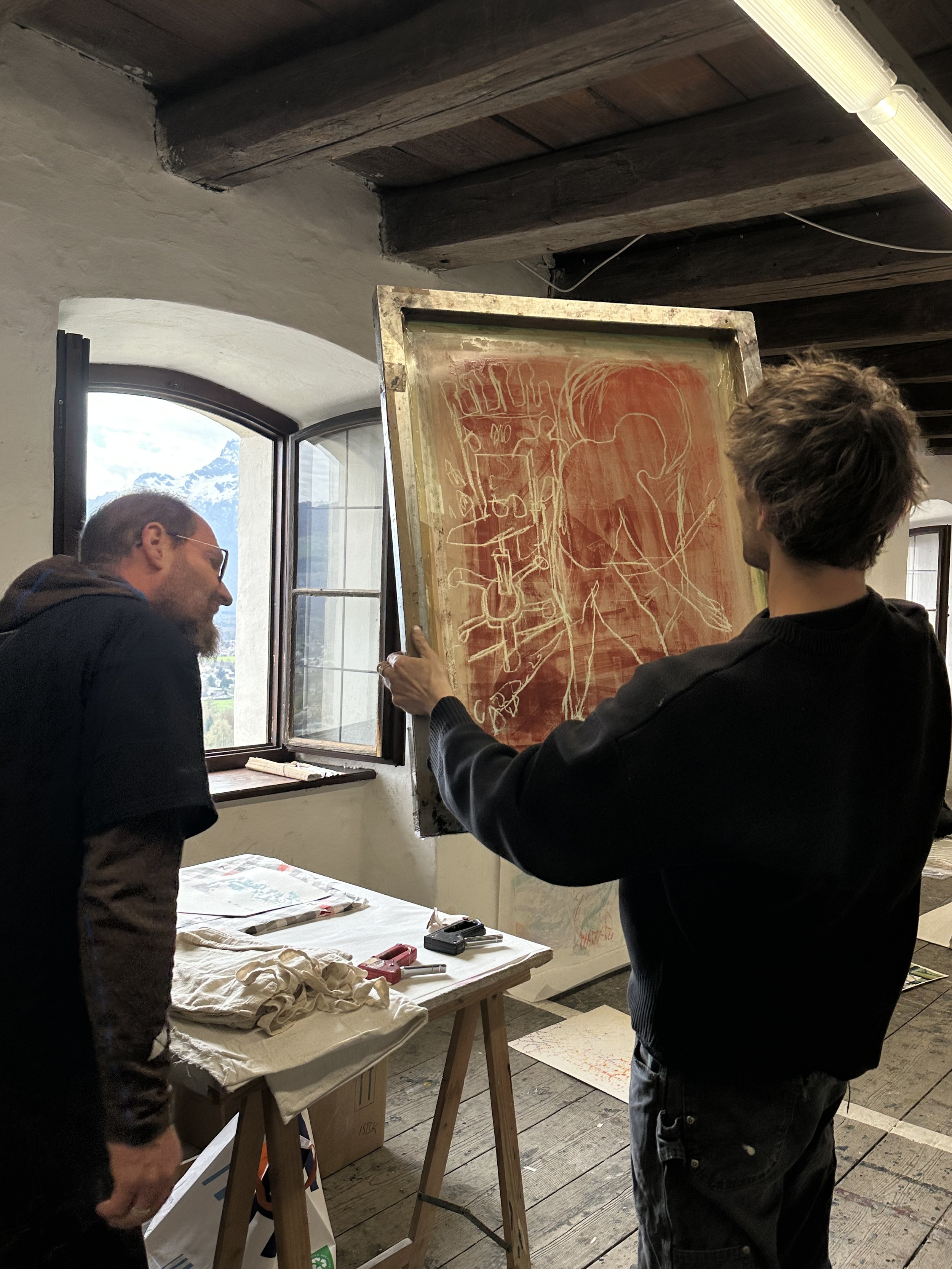
Otis Blease
Deliberation on a Process
After studying Drawing and Printmaking at the University of West England, Bristol in 2018, I undertook a postgraduate scholarship course at The Royal Drawing School, London. Both drawing and printmaking continue to form the basis of much of my work, in addition to sculpture and painting. My work is often an amalgamation of these processes, taking inspiration in instances when these techniques converge.
I currently live and work in Cornwall, UK, making my work from a rurally located studio. I find this solitary working environment important andcomfortable for my practice.
However, whilst making work on this residency, I was reminded of the true value of sharing a space with fellow artists, conversing through words and actions.
Learning through play and experience in the company of other creatively inspired people highlighted to me an essence of visual communication and connection that I so often overlook in favor of a solitary creative space. The act of creating together, exploring the grounds of the fortress whilst exploring the depths of a printing process, brought into focus the power of collaboration, and most of all the power of image making.
In ‘Deliberation on a Process’ I have tried to capture this experience of existing within a creative space; a space built through laughter, conversation, eating, drinking, and of course creating.
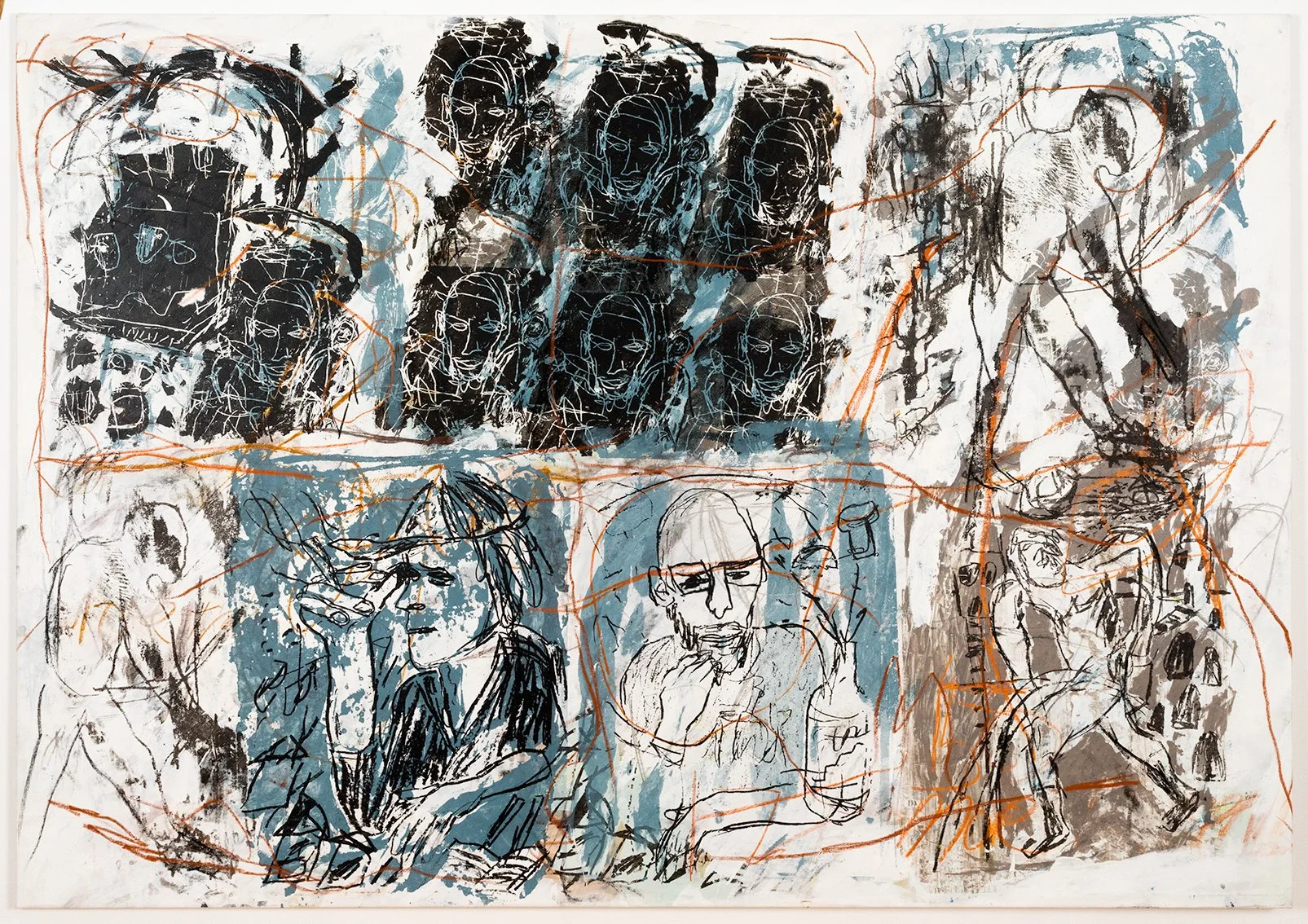
Otis Blease, Big - Small
Martin Gredler
Patron 26
Beobachtung und Imagination bilden den Ausgangspunkt meiner künstlerischen Arbeit. Mich interessieren Übergänge – zwischen Natur und Kultur, Gegenwart und Erinnerung, Sichtbarem und Verborgenem. Die Bilder verstehen sich als offene Räume, die individuelle Assoziationen ermöglichen und den Blick auf das Vertraute verschieben. Kunst ist für mich eine Form des Fragens: Sie macht Zusammenhänge sichtbar und eröffnet neue, manchmal spielerische oder absurde Perspektiven.
Meine Arbeiten entstehen im Dialog zwischen Zeichnung, Malerei und Druckgrafik. Im Zentrum steht die Spur – als sichtbarer Ausdruck einer Handlung, eines Gedankens oder einer Erinnerung. Stein, Holz, Metall oder Das Gewebe des bespannten Rahmens sind nicht bloß Träger eines Bildes, sondern aktive Gegenüber im künstlerischen Prozess. Ihre Oberflächen speichern jede Geste und machen die Entstehung des Bildes nachvollziehbar.
Druckgrafik begreife ich nicht als Medium der Vervielfältigung, sondern als eigenständige künstlerische Sprache. Im Spannungsfeld von Material, handwerklicher Präzision und Zufall entstehen Bilder, die weit über das reproduzierende Abbild hinausweisen. Jeder Druck ist das Ergebnis eines konzentrierten Dialogs zwischen Idee, Material und Technik – eine Form sinnlicher Reflexion.
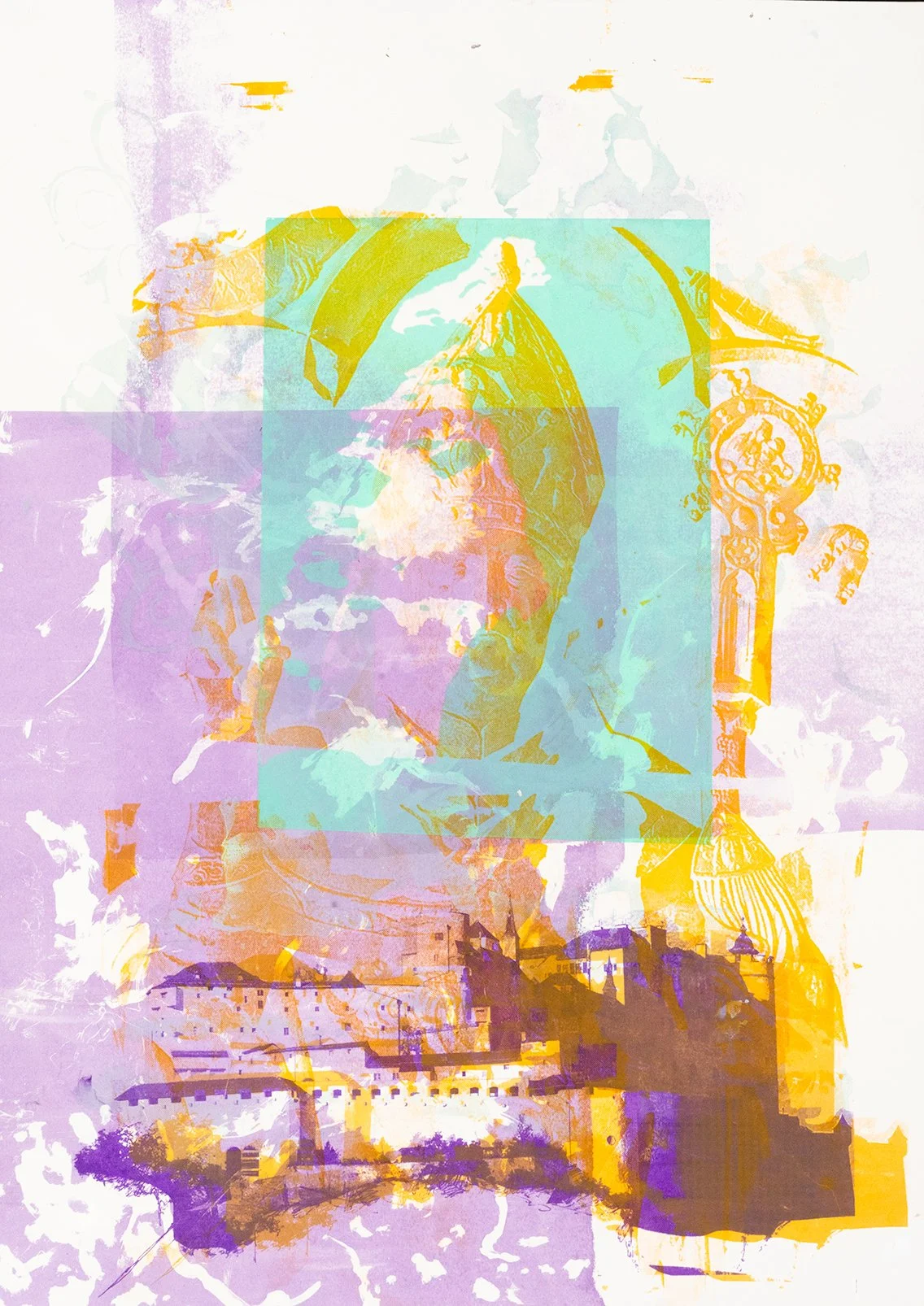
Die Serie „Patron 26“ ist als augenzwinkernde Hommage an Robert Rauschenbergs „Booster“ (1967) entstanden. Die monumentale Lithografie (die eigentlich keine ist) vereint Elemente, die auch meine eigene Bildsprache prägen: Zitat und Collage, autobiografische Fragmente, Ironie sowie die Überlagerung unterschiedlicher Bild- und Bedeutungsebenen.
Das Symposium bot die Möglichkeit, den Siebdruck im Großformat bis an die Grenze zur malerischer Ausdruckskraft zu führen. Der Druckprozess wird dabei selbst zum Pinselstrich und eröffnet neue bildnerische Möglichkeiten.
Kompositorisch nimmt die Serie Bezug auf „Booster“, verbindet diese kunsthistorische Referenz jedoch mit meiner eigenen Bildwelt und den Eindrücken der Festung als Arbeits- und Ausstellungsort. So entsteht eine persönliche Auseinandersetzung mit Erinnerung, Ort und Bildsprache, in der sich kunsthistorisches Zitat und gegenwärtige Erfahrungen miteinander verschränken.
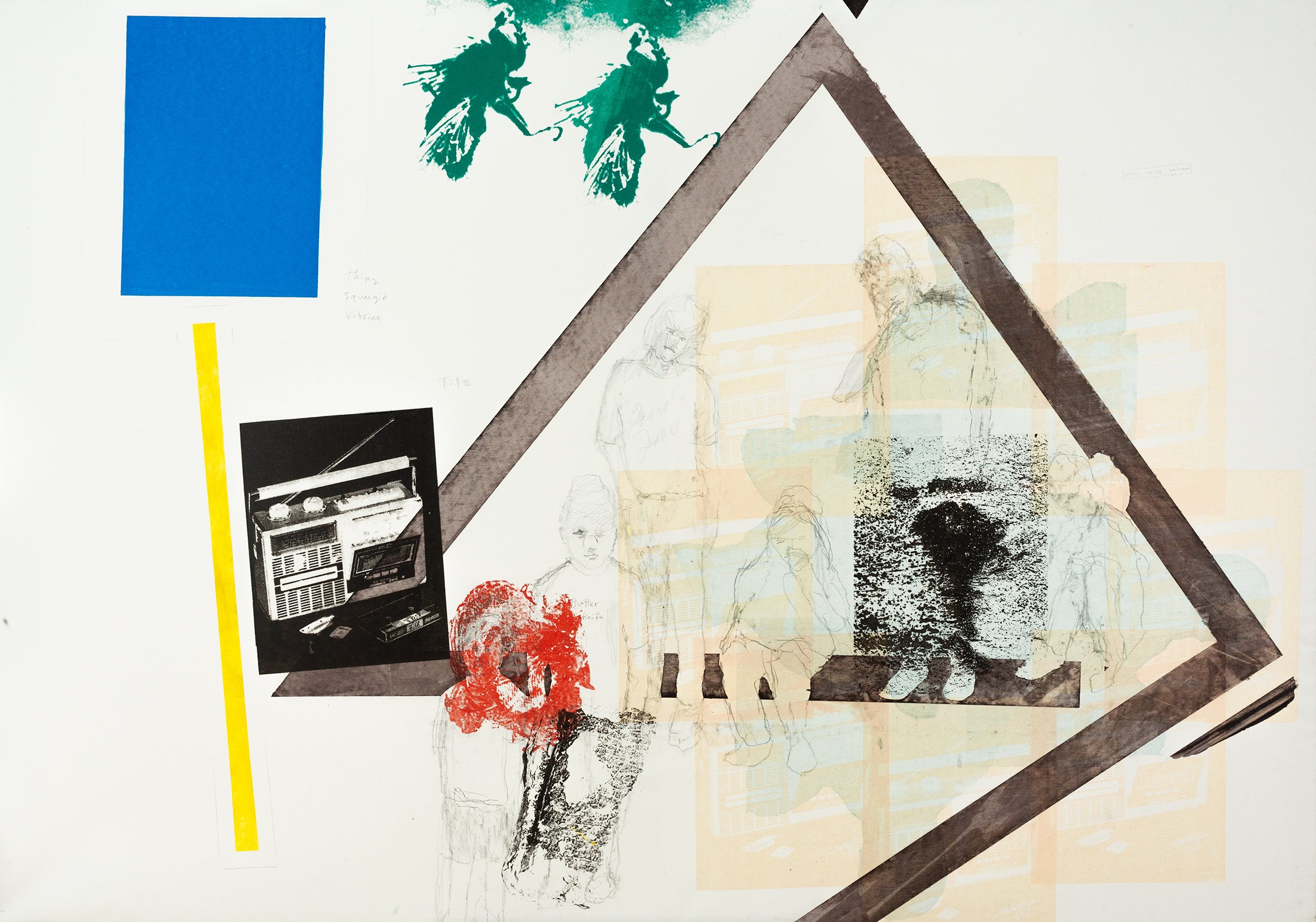
Stephen R. Mathewson, Big - Small
Stephen R. Mathewson
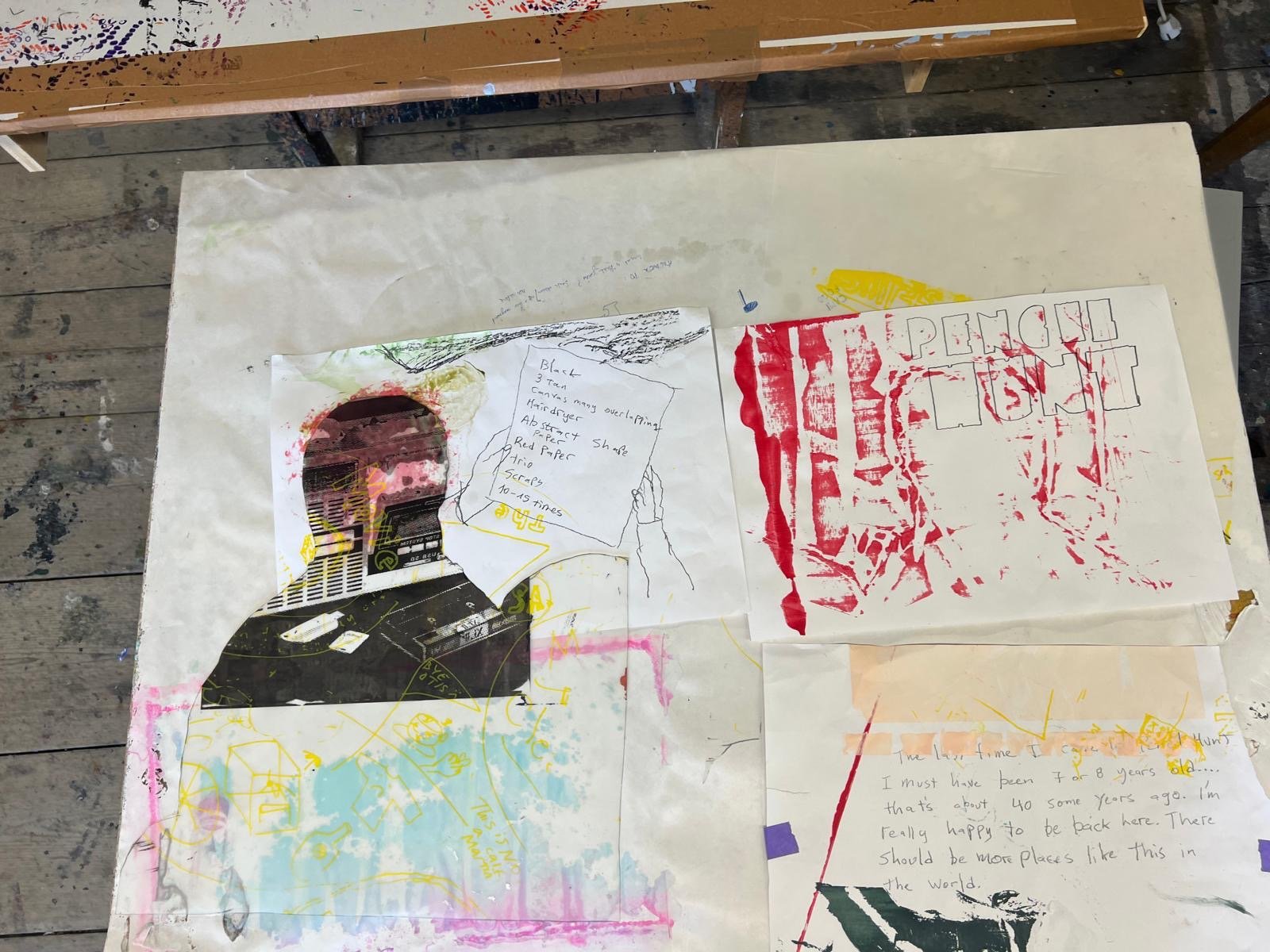
Hello. My name is Pencil Hunt
My approach, my understanding, my intrigue.
To start, it is my opinion that the experiences of an individual’s own life provide an ample supply of personal record as archive to draw from, for creating a wealth of story and compositional material useful for visual art making. Naturally one needs a rather massive supply of willingness begin the working process allowing for accomplishment. I slither between stones of understanding my preconceptions and the motivational side of it all. The red light/green light moment to begin the process is dictated by the question(s)…Why should I begin? Should I begin?
It’s basically a sludge pipe to turn on and shut off.
Additionally, my chain of 35 Summer Academy summers in Salzburg, 16 spent working at the Festung Hohensalzburg provides a rather intimate awareness and relationship with and within the rooms of the Festung. Working for the Whiskey Business project meant involving our thriving social abilities in all processes of the residency, like a band on tour. So, to link with a passage at the beginning of the paragraph, the band members have the option to trade experiences, using another’s as if it were their own.
Hannah Tilson
Patternscape
‘In Tilson’s work, it is possible to experience contrary feelings, inside and outside, all at once, unsure of your speed or direction of travel. Not only does she make us look twice, the sheer audacity of her patterns makes us aware of our very eyeballs, á la Bridget Riley’s op art. Sometimes the intersecting patterns are so busy they could move.‘ - Sammi Gale
April 2026. After having taught four classes in the Festung ground floor print studios, it was a completely different and mind altering experience making my own work there.
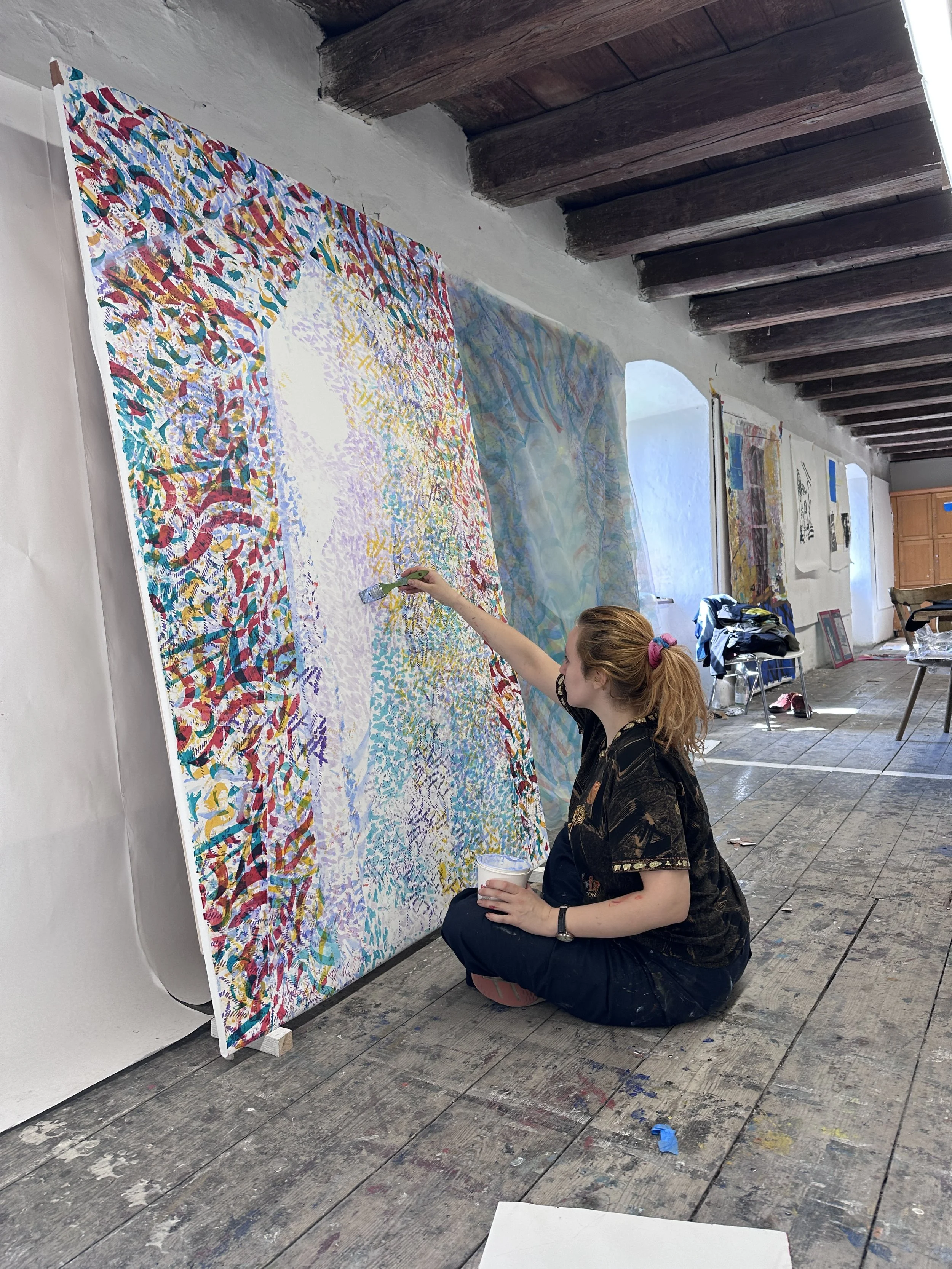
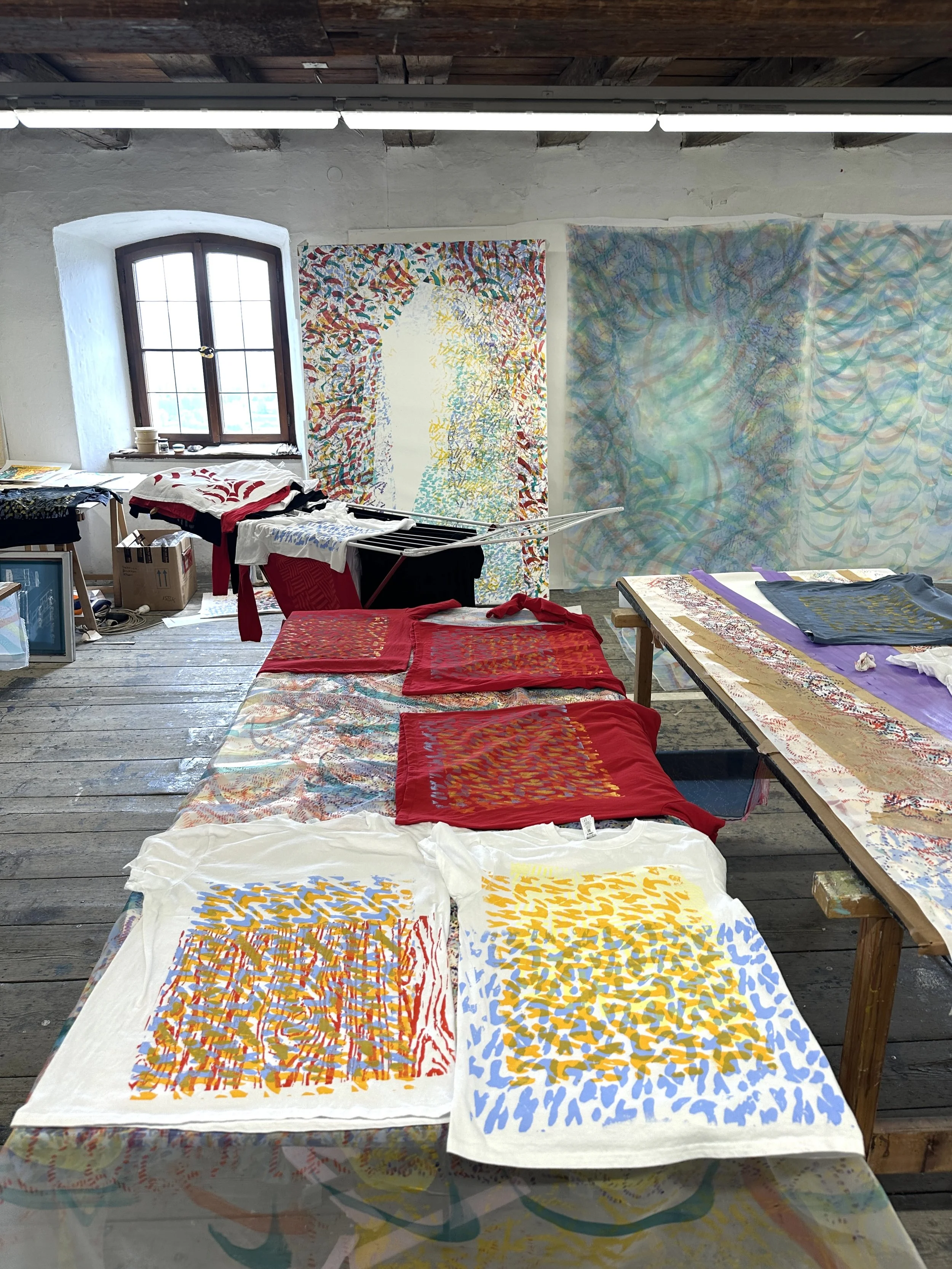
The walk to work, normally full of ideas for what students could be thinking about and learning during the day, turned into an exciting frenzy of plans for my own world building and what we could do as a team up in the festung. I started off working on a huge table which seemed like it had to be the limit of this screenprinting adventure, and ended up needing four more the same size to be able to deliver a fraction of the ideas my happily overstimulated brain was pumping out. Working inside this building humming with history, walking the same paths that so many different characters had walked over time, and having constant discussions with Otis, Martin and Steve lay the foundation for a silkscreen haven. Problem solving and working together as one brain, anything felt possible. No idea was left untouched.
I used the screen in a more ad-hoc way, more paint brush than screen. Allowing it to take on a life of its own. I fell in love with the freedom it offered for colour exploration. My eyes felt reopened to the world, colours humming, clashing, vibrating and singing together. It felt beautifully blinding. Flooding the screens and watching how they reacted on the paper felt like being handed the keys backstage to light up a stage. Shapes that were once pencil marks became glittering, multilayered reflections—like a moving disco ball.
My large canvas was inspired by the mountains surrounding us, the windows showing different glimmers of this monumental skyline around Salzburg as you walked the lengths of the studios. Sometimes completely hidden and eaten up by clouds that crept up and enveloped the festung.
I work in a variety of media: painting, printmaking and installation. Self portraits are built up in layers of colours, concealing, revealing and camouflaging my body in vibrating and fragmented spaces filled with patterns. Viewing my body and the fabrics encompassing her form as a landscape/pattern of rhythmic and geometric forms. Sometimes the figure is completely swallowed up by the fabrics and other times; a hand or a foot surfaces, taking the viewer closer to their own reality. Shapes become a changeable part of a layered world, allowing the viewer to question what they see. In this fast-moving, turbulent space, abstracted through the pattern lens.